- Signpost
- Posts
- 💬 Language: The words of 2025
💬 Language: The words of 2025
English language custodians have picked the words that reflect our zeitgeist.

Imran Khan
December 06, 2025

Analysing meaning and power through language.
Hi Signposter. I enjoy a list or an award. It’s so final it it’s declaration, and is prime fodder for rage bait (Oxford University Press word of the year 2025). Nothing gets people involved or enraged quite like a decisive dictatorial pronouncement over all of humanity.
At Signpost, we analyse language to decode shared meaning and track assumed power. What better way to do that than by analysing the various English language ‘word of the year’s announced by the custodians of the English language. It’s a way for all of us to agree and disagree on what was the most significant cultural moment for us as a global society. Boiling down the entire experience of eight billion human beings into a single word is impossible.
But it’s still fun. And we like to have fun here.
THIS WEEK
💬 Language - The English language words of 2025
Gif by cbs on Giphy
Here is a non-exhaustive list of the words of the year, verbatim from their individual websites, which we will collectively analyse semiotically below:
Rage bait - Oxford University Press
Parasocial - Cambridge Dictionary
Vibe coding - Collins Dictionary
67 (pronounced “six-seven”) - Dictionary.com
AI slop - Macquarie Dictionary
Slop - The Economist
CONTEXT
1️⃣ What is happening?
End-of-year reviews and reflections are media bread-and-butter to not only position themselves as meaning makers but to also allow them a moment of relevance and audacity (I’m doing it right now). News media famously count down the most important events of the year, ranking them in order of impact or awareness. For this issue, linguistic media (dictionaries, magazines, etc.) pick their ‘word of the year’ to represent the zeitgeist reflective of an entire 12 month period.
My awareness is only of English language words of the year, but I suspect other languages do their own versions of this (if you know, I’d be curious to find out what words come up in other languages). Methodologies differ; some use public voting, others use search volumes, still others pick the words themselves. The result is the same, a word that represents our lived experience most commonly.
Cue the disagreements.
2️⃣ What was written, and to whom?
These words are chosen to position the word-chooser in some authority, to reflect their deep understanding of the language (and thoughts) of the people. However, these projects also allow for media coverage that would usually not happen (when was the last time you read a news article about Collins Dictionary? Or even thought about a dictionary?). So it’s as much educational awareness as it is marketing awareness.
It is also a message to the rest of the us, informing us of the words we’ve used and the words that describe us this year. You don’t have to like it, but you will have an opinion about it.
Because it’s words. Everybody knows words. And words are powerful emotional triggers.
ANALYSING THE TEXT
Note: Under ‘What it Says’, I have copied the definitions of the words directly from their respective websites. You can click on the words themselves to find out more.
Words / Phrases | What it Says | What it Means |
|---|---|---|
noun - online content deliberately designed to elicit anger or outrage by being frustrating, provocative, or offensive, typically posted in order to increase traffic to or engagement with a particular web page or social media account. | the internet is an angry place | |
adjective - involving or relating to a connection that someone feels between themselves and a famous person they do not know, a character in a book, film, TV series, etc., or an artificial intelligence. | we have forgotten how to connect with human beings in the real world | |
an emerging software development that turns natural language into computer code using AI. The term was popularised by Andrej Karpathy, former Director of AI at Tesla and founding engineer at OpenAI, to describe how AI enables creative output while he could “forget that the code even exists”. | in the age of AI, people want to build things without expertise | |
Some say it means “so-so,” or “maybe this, maybe that,” especially when paired with its signature hand gesture where both palms face up and move alternately up and down. Some youngsters, sensing an opportunity to reliably frustrate their elders, will use it to stand in for a reply to just about any question. It’s meaningless, ubiquitous, and nonsensical. | youth continue to invent new language to frustrate older folks | |
noun - colloquial low-quality content created by generative AI, often containing errors, and not requested by the user. | the AI revolution is not as advertised | |
Slop (paywall) | Our pick’s rise was spurred by OpenAI’s release of Sora, a generative artificial-intelligence (AI) platform that can create videos based on a prompt. Suddenly social-media feeds were filled with such clips. A term that started circulating in the early years of generative AI is now everywhere: “slop”. | new content on the internet is trash |
DECONSTRUCTING THE TEXT
🗝️ Unlocking Meaning
Let’s look at these words together. Every single word mentioned here directly relates to online culture in some way. Some skew negative (rage bait, AI slop, and slop), while others skew neutral (67, parasocial). Only one can be perceived as positive (vibe coding). So what does this tell us?
First, online culture is culture. There is no meaningful barrier between what happens online and what behaviour that drives offline. It’s interdependent and has real world impact. Second, based on these words, the digital world is having a more negative impact on us than positive, at least in 2025. We are consuming badly made and badly designed content online (AI slop, slop) which usually makes us angry (rage bait) and creates false feelings of connections with unreal beings (parasocial). In response, we create meaningless phrases (67) and pretend to build stuff (vibe coding).
👑 Power Play
The internet, and digital culture in general, has eaten into the relevance and reach of all the word-of-the-year awarders. Which is why they are likely to be suspicious and negative of all things digital. Howver, to borrow the phrase ‘rage bait’, it is well known that negative news leads to more engagement online. And in the current cultural space we are right now, where words like ‘permacrisis’ permeate our political and personal perspective, these words reflect and build on our existing approach to life, i.e. everything sucks and is only getting worse.
Ultimately, it’s good to remember that these are simply words, and they only have power over us if we assign power to them. Even if we all agree with their definitions, what they mean for us individually, or how they influence our perspective of our own and collective lives, is for us to decide.
And lucky for us, we have a brand new year ahead of us to decide the words of 2026.
WHAT DO YOU THINK?
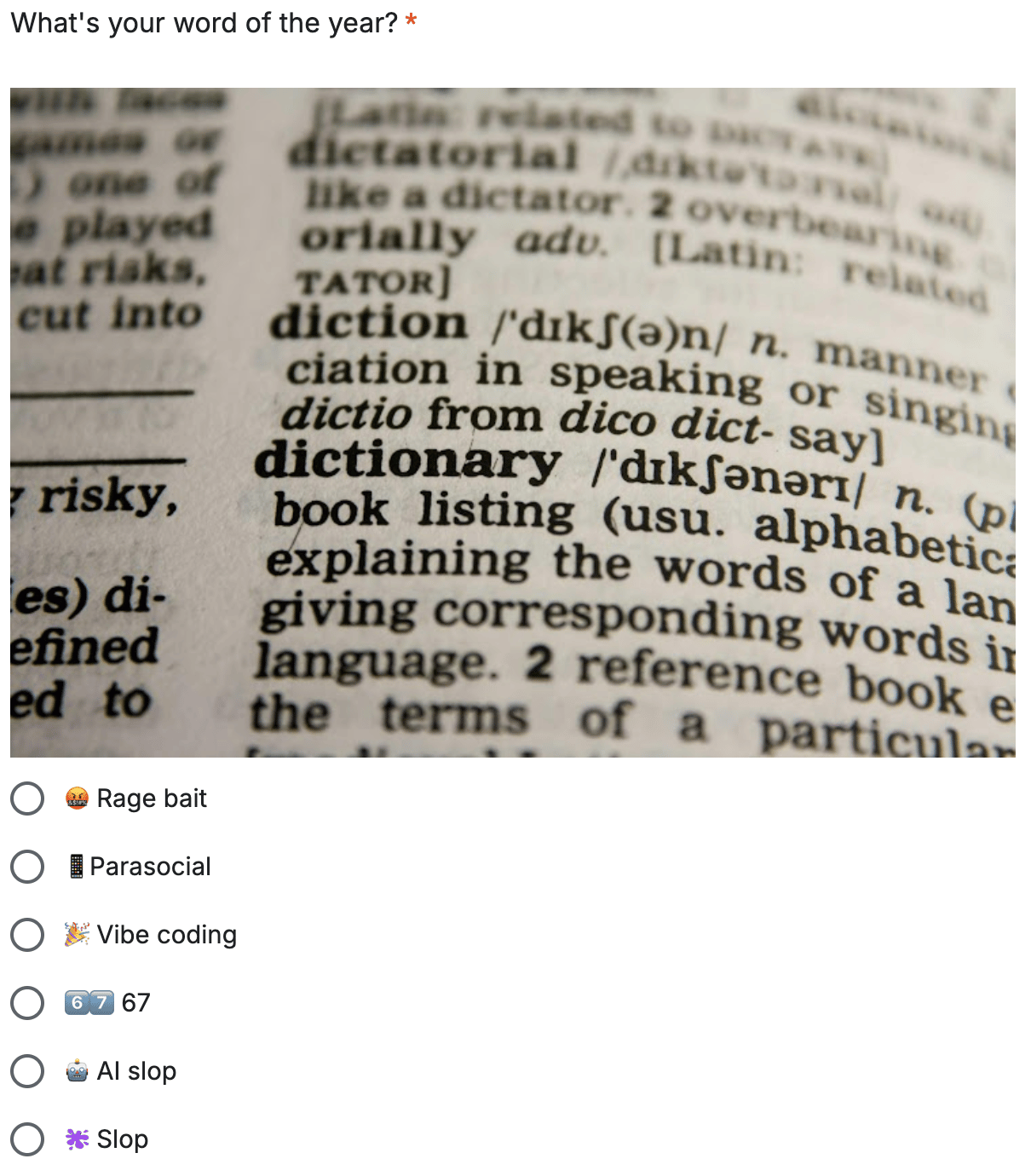
Tell me your reasoning. In next week’s issue, I’ll highlight the most thought-provoking responses.
NEXT WEEK ON SIGNPOST
No promises, but we will likely cover the comments from the winners and losers of the 2025 Formula 1 season, one of the most exciting in years.
Was this forwarded to you? Signpost is a free weekly newsletter analysing meaning and power through language. It’s free to subscribe.
Think somebody else would enjoy this? Send them here.